Bridge Pose looks simple. But it is one of the most powerful poses in yoga. It opens the chest, strengthens the back, and calms the mind — all at the same time. Many people do it wrong though. Wrong form means less benefits and more pain. This guide will teach you the right way to do Bridge Pose, why it is so good for your body, how to align it correctly, and what mistakes to avoid. Whether you are a beginner or have been doing yoga for years — this guide will help you get more from this pose.
What Is Bridge Pose (Setu Bandhasana)
The name comes from Sanskrit. Setu means bridge. Bandha means lock or bind. Asana means pose. So Setu Bandhasana means — a pose that forms a bridge with your body.
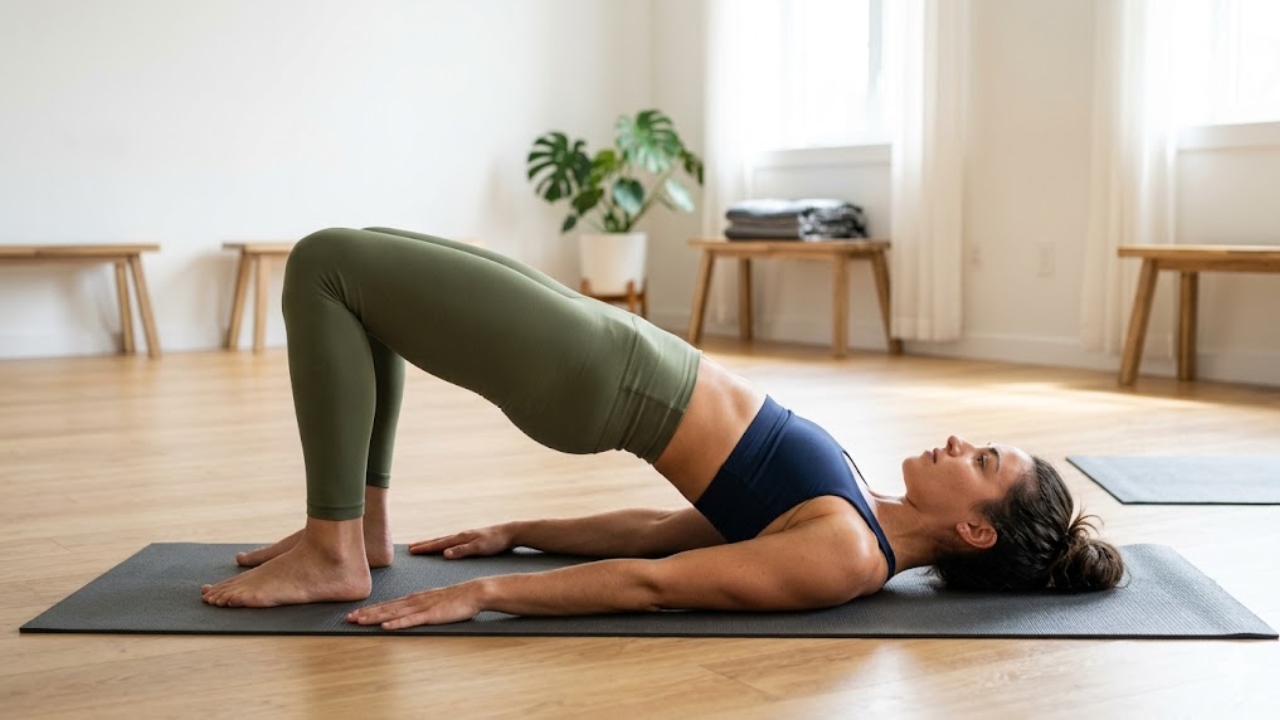
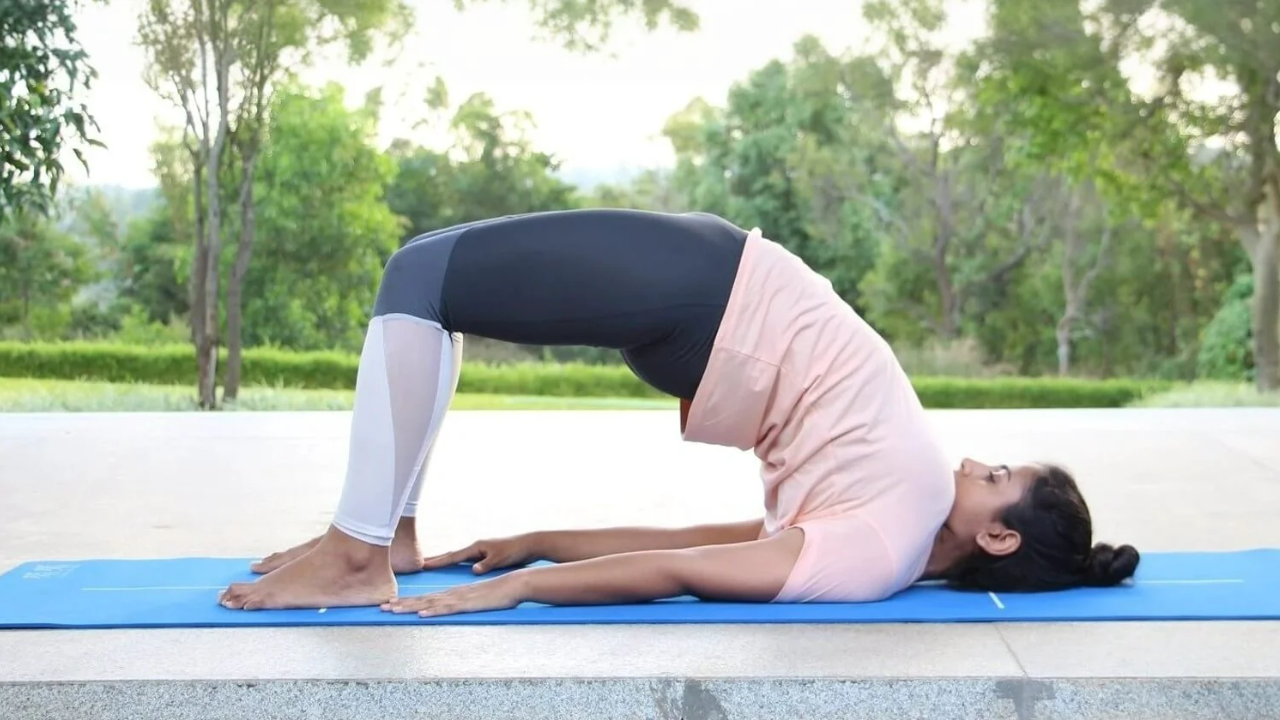
You lie on your back, bend your knees, and lift your hips up. Your body forms the shape of a bridge — flat in the middle, supported at both ends. It is a backbend. But it is a gentle one. Safe for most people. Easy to learn. Very rewarding.
It is used in yoga, physiotherapy, and sports training worldwide. That tells you how useful this pose really is.
Quick Facts About Bridge Pose
- Sanskrit Name: Setu Bandha Sarvangasana / Setu Bandhasana
- Type: Backbend / Chest Opener
- Level: Beginner to Intermediate
- Hold Time: 20 seconds to 1 minute
- Best Time: Morning or evening on an empty stomach
- Target Areas: Glutes, hamstrings, spine, chest, thyroid, core
- Preparatory Poses: Supine Twist, Cat-Cow, Child Pose
Top Benefits of Bridge Pose
Bridge Pose is not just a stretch. It works many parts of your body and mind at the same time. Here are the most important benefits — backed by yoga tradition and modern research.
Strengthens the Back and Spine
- Directly works the erector spinae muscles — the muscles along your spine.
- Regular practice builds a strong, supported back.
- Reduces chronic lower back pain that many desk workers experience.
- Improves spinal flexibility and range of motion over time.
Tones Glutes and Hamstrings
- Every time you lift your hips, your glutes work hard.
- Hamstrings activate and stretch at the same time — a rare combination.
- Consistent practice firms and tones the lower body naturally.
- Works better than many gym exercises for the posterior chain.
Opens the Chest and Shoulders
- Most people sit hunched all day. This closes the chest and tightens the shoulders.
- Bridge Pose directly reverses this — it opens the front of the body.
- Improves posture visibly within a few weeks of regular practice.
- Increases lung capacity and deepens breathing.
Stimulates the Thyroid Gland
- The chin-to-chest position in Bridge Pose gently compresses the throat area.
- This stimulates the thyroid and parathyroid glands.
- Helps regulate metabolism — which affects weight, energy, and mood.
- Very useful for people with thyroid issues (with doctor approval).
Calms the Mind and Reduces Stress
- Bridge Pose activates the parasympathetic nervous system — the "rest and digest" mode.
- It reduces cortisol (the stress hormone) in the body.
- Holding the pose with deep breathing works like a natural anxiety reliever.
- Many yoga teachers recommend it before sleep to improve sleep quality.
Improves Digestion
- Lifting the hips massages the abdominal organs.
- Stimulates the liver, kidneys, and intestines.
- Helps with bloating, constipation, and slow digestion.
- Best done in the morning before breakfast for digestive benefits.
How to Do Bridge Pose – Step by Step
Follow these steps carefully. Correct setup at the beginning makes a big difference. Take your time. Do not rush into the lift.
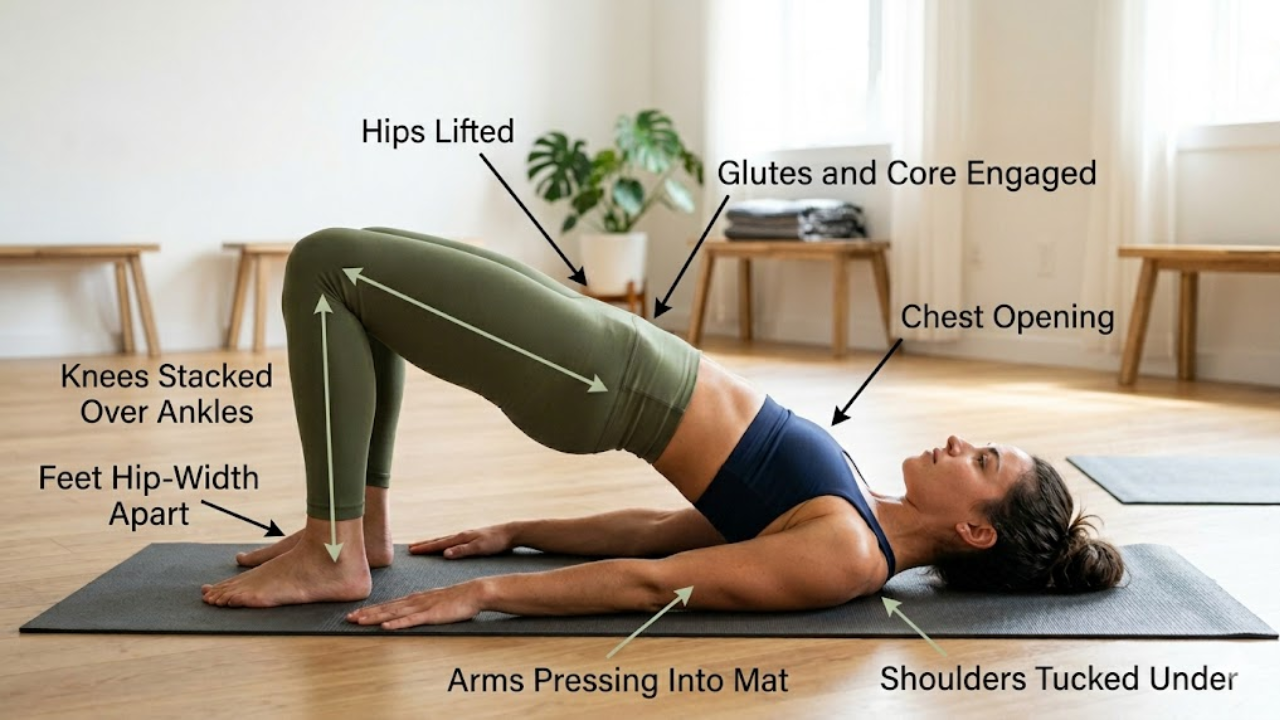
- Step 1 – Lie Down Flat: Lie on your back on a yoga mat. Keep your arms by your sides with palms facing down. Legs straight. Take two to three deep breaths and relax your body fully.
- Step 2 – Set Up Your Feet: Bend your knees and bring your feet flat on the mat. Feet should be hip-width apart. Place them close enough to your hips so your fingertips can just touch your heels. This is the key distance — not too close, not too far.
- Step 3 – Press the Feet Down: Press all four corners of both feet firmly into the mat — big toe, little toe, and both sides of the heel. This grounding gives you stability for the lift.
- Step 4 – Inhale and Lift: Take a slow inhale. As you breathe in, press into your feet and slowly lift your hips off the floor. Lift from the pelvis first, then the lower back, then the mid back. Go one vertebra at a time — like peeling your spine off the mat.
- Step 5 – Interlace Your Hands (Optional): Once the hips are lifted, you can roll your shoulders under and interlace your fingers under your back. This helps open the chest more and creates a firmer base. Press the outer edges of your arms into the mat.
- Step 6 – Lift and Hold: Push the hips as high as they comfortably go. Knees stay directly over ankles — not falling in or out. Squeeze the glutes gently. Chin moves slightly toward the chest. Hold for 20 to 45 seconds. Keep breathing normally.
- Step 7 – Come Down Slowly: On an exhale, slowly lower the hips back down — spine first, then tailbone last. Do NOT drop the hips suddenly. The slow release protects your spine and adds extra strength work. Rest for 10 to 15 seconds and repeat.
Bridge Pose Alignment – Get It Right
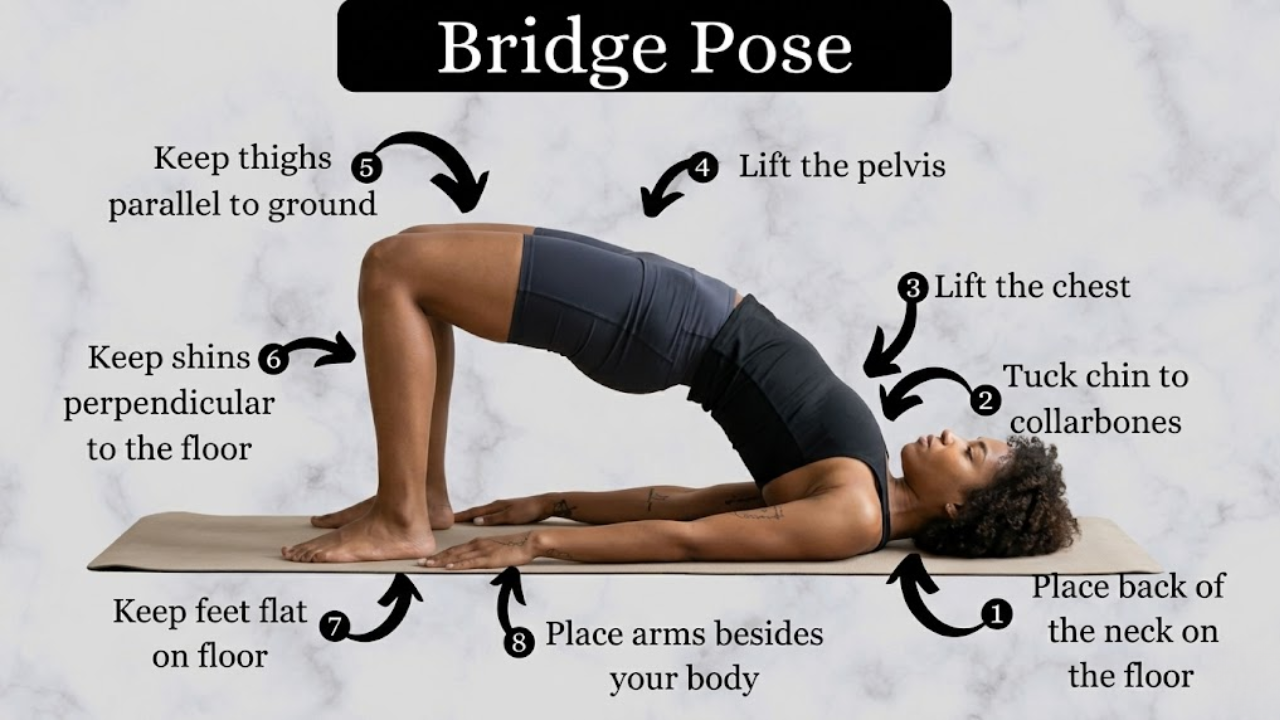
Alignment is everything in Bridge Pose. Wrong alignment means less benefit and possible pain. These alignment cues will help you do it correctly every single time.
Feet and Knees
- Feet should be parallel — toes pointing straight forward, not out to the sides.
- Knees should stay directly above the ankles throughout the hold.
- Do not let the knees fall in (toward each other) or splay out wide.
- If knees keep falling in — place a yoga block between your thighs. Squeeze it gently. This cue fixes knee alignment instantly.
Hips and Pelvis
- Hips should be level — do not let one hip drop lower than the other.
- Lift the hips high enough that your thighs are roughly parallel to the floor.
- Engage the glutes but do not over-squeeze. Gentle squeeze is enough.
- Pelvis should be in a neutral position — not tucked too far under or tipped too far forward.
Spine and Back
- The spine should form a smooth gentle arc — not a sharp angle.
- Do not let the lower back collapse or over-arch aggressively.
- Keep the core lightly engaged to protect the lower back.
- The mid-back should stay broad and not compress on one side.
Shoulders, Arms and Neck
- Shoulders roll underneath the body — not up toward the ears.
- Arms press into the mat to create a stable base for the chest lift.
- Chin moves slightly toward the chest — this protects the neck.
- Never turn the head left or right while the hips are lifted. This can injure the neck.
Bridge Pose Variations for All Levels
Bridge Pose has simple variations for beginners and harder versions for advanced practitioners. Start where you are. Progress naturally.
- Supported Bridge Pose (Beginner): Place a yoga block under your sacrum (the flat bone at the base of your spine). Rest your hips on the block. This is a restorative version — very calming and gentle. Great for lower back pain and beginners.
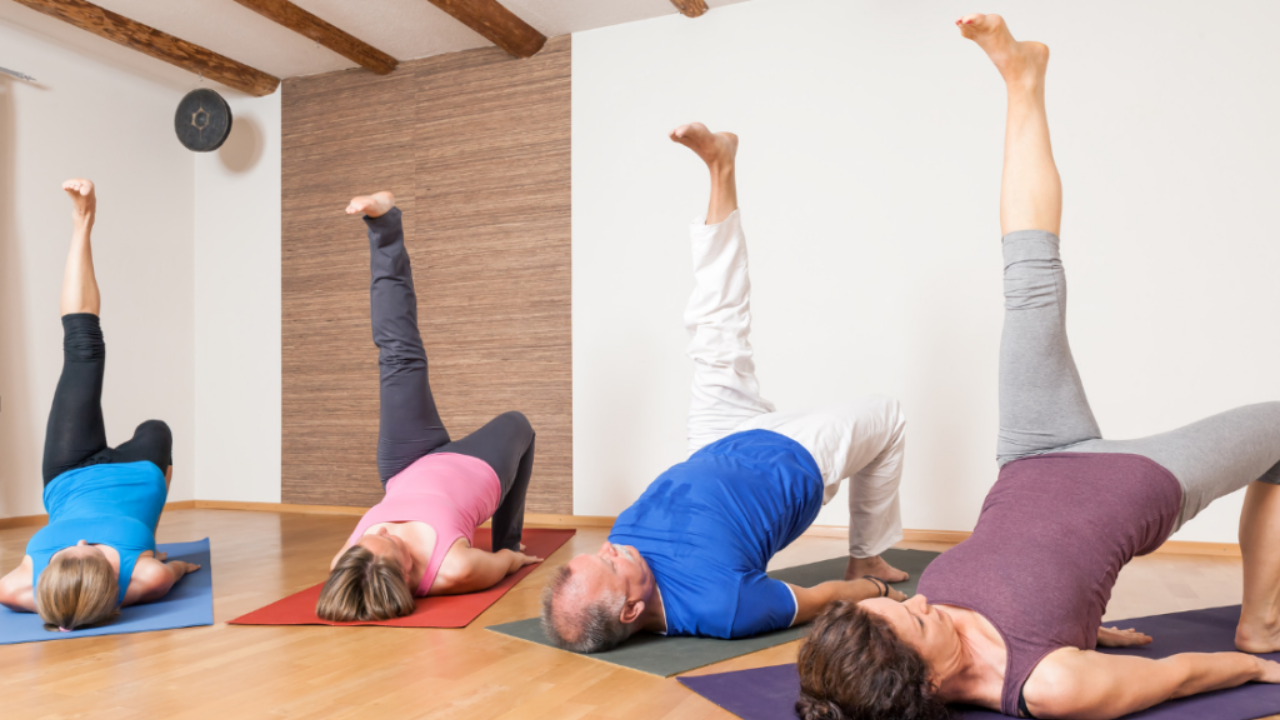
- One-Leg Bridge Pose (Intermediate): Get into Bridge Pose. Then slowly lift one leg straight up toward the ceiling. Hold for 15 to 20 seconds. Switch sides. This increases glute work and challenges balance. Do this only once the basic bridge feels stable.
- Block-Between-Thighs Bridge (Alignment Tool): Place a yoga block between the inner thighs. Squeeze it gently while you lift. This activates the inner thighs and fixes knee alignment at the same time. Very useful for people whose knees keep falling inward.
- Bridge with Arms Lifted (Strength Focus): Instead of interlacing fingers under the back — keep your arms lifted straight up toward the ceiling. This removes the shoulder support and forces the back and glutes to work harder. Advanced variation.
- Dynamic Bridge (Flowing Version): Inhale to lift the hips. Exhale to lower them slowly — but do not touch the floor fully. Inhale and lift again. Repeat 10 to 15 times in a flowing rhythm. This builds endurance and increases the burn in the glutes.
Common Mistakes in Bridge Pose
These are the mistakes most people make. Fixing even one of these will immediately improve your Bridge Pose and the results you get from it.
- Feet Too Far From the Hips: If your feet are too far away, you cannot lift high and the glutes barely work. Bring the feet closer — your fingertips should touch your heels when arms are beside the body.
- Knees Falling Inward: This is very common. It reduces hip lift and puts pressure on the knees. Fix it with a block between the thighs or actively push the knees outward during the hold.
- Holding the Breath: Many people lift and then stop breathing. This creates tension and reduces the calming benefit of the pose. Breathe slow and steady throughout the entire hold. Inhale to lift, exhale to hold or lower.
- Dropping the Hips Fast: Coming down with a thud is lazy and risky. Lowering slowly protects the spine and adds extra strength training. Go down one vertebra at a time — always.
- Turning the Head During the Pose: When the neck is compressed in Bridge Pose, turning the head can injure the cervical spine. Keep the head centered and still for the entire duration. Look straight up.
- Not Engaging the Core: Letting the belly completely relax puts extra pressure on the lower back. Keep a light engagement in the core — like you are gently pulling the navel toward the spine. This protects the lumbar spine.
Who Should Avoid Bridge Pose
Bridge Pose is safe for most people. But a few conditions need caution. Always listen to your body first.
- Neck Injury or Cervical Problem: The neck is compressed in this pose. If you have any neck injury, disc problem, or cervical spondylosis — skip this pose or do the supported version with a bolster under the hips only, not a full lift.
- Severe Lower Back Injury: If you have a herniated disc or have recently had back surgery — consult a doctor or qualified yoga teacher before trying Bridge Pose. Do not practice on your own with a serious back condition.
- Knee Pain or Recent Knee Surgery: The knee is in a bent position under load in this pose. If there is sharp knee pain during the setup — place less weight on the knees or skip this pose temporarily.
- Pregnancy (Second and Third Trimester): Avoid active Bridge Pose. Use a supported version with a bolster under the sacrum instead. Always practice under the guidance of a prenatal yoga teacher during pregnancy.
- High Blood Pressure: Active backbends can affect blood pressure. If you have uncontrolled high blood pressure — use the supported version only and avoid holding for long durations.
When and How Often to Do Bridge Pose
The good news is — Bridge Pose can be done every single day. It is safe, gentle, and beneficial for daily practice. Here is how to fit it into your routine.
- Morning Practice: Do 3 to 5 rounds in the morning on an empty stomach. It activates the back and glutes, opens the chest, and sets up good posture for the whole day. It also stimulates the digestive system early.
- Before Bed: Use the Supported Bridge Pose (with a block under the sacrum) before sleep. Hold for 1 to 3 minutes. It calms the nervous system, releases the lower back, and improves sleep quality noticeably.
- After Desk Work: After sitting for hours, the hip flexors get tight and the back gets weak. 3 rounds of Bridge Pose after work instantly restores spinal length and relieves that heavy feeling in the lower back.
- After a Workout: Bridge Pose is a great cool-down pose after running, cycling, or gym sessions. It stretches the hip flexors and quads while strengthening the posterior chain — a perfect recovery tool.
- Recommended Frequency: Daily is fine. 3 to 5 rounds per session. Hold each round for 30 to 45 seconds. Beginners can start with 3 rounds of 20 seconds and build from there.
What to Feel in Bridge Pose — and What Not to Feel
Knowing what is normal and what is a warning sign helps you practice safely and confidently.
- Normal: Burning in the Glutes. This means the pose is working. Glutes are under real load. This is a good sign. Breathe through it.
- Normal: Stretch in the Front of the Hips. The hip flexors stretch in this pose. Some tightness in the front of the hips is expected — especially if you sit a lot during the day.
- Normal: Mild Effort in the Lower Back. A feeling of gentle engagement in the lower back muscles is normal. It should feel like muscle effort — not pain.
- Warning: Sharp Pain in the Neck. If you feel sharp or pinching pain in the neck — come out of the pose immediately. This means the neck is not properly positioned or has a pre-existing issue.
- Warning: Sharp Pain in the Knees. Mild discomfort in the knees is sometimes normal at first. But sharp, stabbing pain in the knee joint is a sign to stop and reassess your foot position or practice a modified version.
- Warning: Tingling or Numbness. If you feel any tingling or numbness in the hands, feet, or back — come down slowly and rest. This is a signal from the nervous system. Do not push through it.
Frequently Asked Questions (Bridge Pose – Setu Bandhasana)
Conclusion
Bridge Pose is small but powerful. It builds a stronger back, opens a tight chest, tones the glutes, and calms a stressed mind — all in one simple move. Most people do it wrong because they rush the setup. Take your time. Place the feet correctly. Lift slowly. Hold with awareness. Lower with control.
Do 3 to 5 rounds daily. Morning or evening — both work. Add it to your yoga routine today. Within two to three weeks, you will notice a stronger back, better posture, and noticeably less tension in the body.
Bridge Pose is one of those poses that never stops giving. The more correctly you do it — the more benefit you get. Start simple. Stay consistent. Let the pose teach you.
At Adishesh Yoga in Rishikesh, we guide students through poses like Bridge Pose with precise alignment and individual attention. Whether you are a complete beginner or want to deepen your practice — we have a program built for your goals.